


Introduction: the foreman won't type
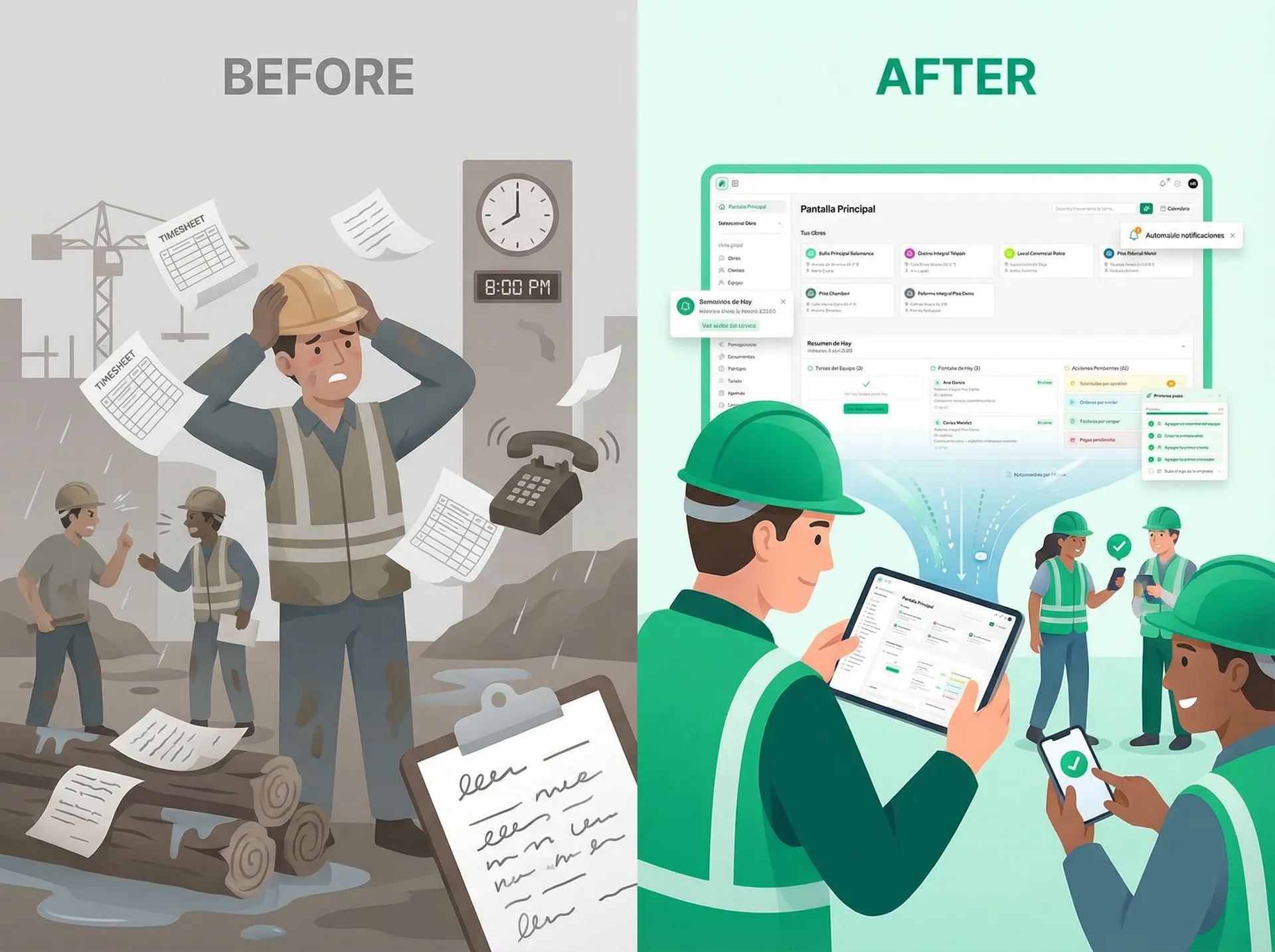
Talk to any site manager and you hear the same story. The studio bought a management tool, paid for the seats, onboarded everyone. Three weeks later the foreman is still firing voice notes into WhatsApp and snapping photos of delivery notes that nobody ever enters anywhere. It isn't that he rejects technology. It's that typing on a phone, standing on a slab, with gloves on and in a hurry, is genuinely miserable. Every form you ask him to fill in competes with the real work he has to do, and the real work always wins.
That's the uncomfortable secret of the sector. The cost of construction software isn't the licence. It's the data entry. It's the hours someone spends transcribing, copying, classifying and reconciling information that already exists somewhere: in the foreman's head, on the supplier's paper, on a manufacturer's web page, in an architect's PDF. Moving that information by hand, field by field, is where the budget burns and where good digitisation intentions quietly die.
Artificial intelligence has been sold to construction as if it were going to design buildings on its own. We're not interested in that promise. We're interested in a far humbler and far more profitable one: getting AI to take the keyboard out of the way. Let the data flow in on its own, or nearly so, and let the person simply confirm it. At Tabiquo we built the product around that idea, and in this article we'll show you exactly where and how.
Voice as the site interface
Dictate instead of typing
A site worker's phone has an excellent microphone and a terrible keyboard for those hands. So the first rule is obvious: if they can speak, don't make them write. The Tabiquo app lets workers dictate the daily work report, the site-visit minute, the meeting minute, and even a project's full room list. The audio is uploaded and automatically transcribed by speech recognition, and here's the first detail that matters: the transcription is aware of the team's language. If your studio works in Spanish it transcribes in Spanish; if it works in Italian or English it does so in that language. It doesn't force a default language that then mangles proper nouns and trade terms.
Transcribing audio on site has a non-trivial technical problem: the per-minute request limits of the speech service. When several workers dictate at once at the end of the day, you easily hit a limit. Instead of throwing a blunt error, Tabiquo retries with a staggered back-off, honouring the wait time the service asks for, and only if there is genuinely no way through does it warn you with a clear message. And it distinguishes two situations most tools confuse: "the service is busy, wait a few seconds" versus "the account has run out of AI credit." That honesty saves hours of support tickets and distrust.
From voice to a structured form
Transcribing isn't enough. A paragraph dictated in one breath isn't a work report: it's text. The second step turns that free text into structured data. When the foreman dictates "today we had five labourers and two skilled workers, we finished the first-floor screed, it rained in the morning and the crane was down for two hours," Tabiquo splits that into its fields: workforce, activities completed, observations, incidents. The site diary fills in its part, the site visit fills in its own, the meeting minute fills in its own. Each document type has its own structure, and the AI maps the voice onto the correct one.
The room-list case is especially neat because it shows the full pattern. You dictate or paste a description of the home — "24-square-metre living room, two bedrooms, master bathroom with a walk-in shower, eat-in kitchen" — and Tabiquo hands back rows ready for review: room name, room type, area in square metres, width, length, height and notes. And it goes further: it tries to resolve each room's type against your real catalogue of room types, so "bedroom" gets linked to the correct type in your database. Anything it can't confidently match it leaves blank, and here's the honest bit: each suggestion comes with a confidence level and, if it's missing something to decide, it tells you so explicitly in a list of clarifications. You confirm or correct in an editable step. The AI pre-fills; the person validates.
OCR: let the paper enter itself
Delivery notes (albaranes / DDT)
The delivery note is the most abused document on a building site. It arrives with the truck, someone signs it, it goes into a plastic folder and — with luck — weeks later someone types it up to cross-check against the order. That manual cross-check is exactly where invoiced materials that never arrived get lost, and deliveries nobody reconciled vanish.
Tabiquo reads the delivery note with OCR from a photo or a PDF: the worker photographs it right there at the loading bay and the system extracts the header and the line items. It accepts PDF, JPEG and PNG, so it works both for the document the supplier emails and for the crooked photo taken in the sun. Then it does the thing that actually saves time: it matches each extracted line against the lines of the corresponding purchase order. It doesn't demand an exact textual match — the supplier writes "grey cement CEM II 25kg" where you had "cement bag CEM II/B-L 32.5 R" — but uses fuzzy matching with a confidence threshold. It only proposes linking a line when confidence clears the bar; anything doubtful is left for you to decide. The result is a delivery-to-order reconciliation that used to be half a morning of spreadsheet work.
Invoices and receipts
The same machine works on supplier invoices. The invoice OCR extracts the document number, issue and due dates, net total, tax and gross total. But the detail that separates a useful tool from a toy is what it does next: it tries to identify the supplier by their VAT/tax ID and, if it finds an entity with that fiscal identifier in your system, links the invoice automatically to the right supplier. No picking from a dropdown of three hundred names. And for everyday small spend — the hardware store, fuel, the crew's lunch — there's receipt reading too, because that small unjustified expense is precisely the one nobody wants to type.
Estimates and catalogue: from natural language to commercial data
Generate an estimate from a description
Writing a construction estimate is one of the slowest tasks there is: line by line, unit by unit, with measurements and prices. Tabiquo lets you start from natural language or from a document. You type — or upload the architect's PDF, or the scope document — and the AI proposes structured line items. But generating raw lines is worthless if the prices are made up, so the system enriches them with prices from your own database and then applies your studio's instructions: the default margin you have configured, the default VAT rate (21% unless you set another) and the free-text guidance you've saved in your team's AI settings. In other words, it doesn't hand you "a generic internet estimate" — it gives you a first draft that already breathes like yours. From there you edit, adjust and close as always.
It also tries to fit each line into your real work phases and chapters, so the estimate is born organised by the structure you actually use, not by some foreign taxonomy.
Import materials from a URL
Adding materials to a catalogue is pure data entry: name, brand, model, reference, colour, dimensions, unit, price, image. Tabiquo lets you paste the URL of a manufacturer's or retailer's product page and fills in the catalogue entry for you. Under the hood it downloads the page, extracts the fields and even pulls in the main product image. It works even with big-box retailers that put up anti-bot barriers, because the request is made imitating a real browser. And if you pass it the team, it also suggests the material's category by matching it against the categories you've already defined. A material that used to be five minutes of copy-pasting between tabs becomes paste a link and review.
Match free-text to the catalogue
In practice people write materials however it comes out: in an order, in a material request, in a stray line. When someone types a free name, Tabiquo suggests materials from your catalogue. First it looks for an exact or partial match directly in the database — fast and cheap — and only if it doesn't find one does it fall back to AI for a fuzzy match. Each suggestion comes with its confidence score and a short reason why. That way the catalogue doesn't fill up with duplicates ("screw 4x40", "screws 4 x 40 mm", "scr. 4x40") that later make any purchasing analysis impossible.
Tasks and questions in natural language
Create tasks by talking
The same philosophy applies to tasks. Instead of a form with ten fields, you write the task the way you'd say it — "call the plumber on Monday for the second-floor bathroom check" — and Tabiquo interprets it into structured data with its title, its date and its context. The friction of creating a task drops so far that people actually create them, which is exactly what you want.
Ask your data without knowing how to query
And at the other end, once the data is in, you don't want to force anyone to build reports. Tabiquo includes natural-language analytics: you ask in plain English "how much have I spent on this project versus the budget?" and the system interprets the question and answers it over your data, even offering you common questions to start from. It's the same old idea seen from the other side: removing the manual work of going to find the figure.
Conclusion: good AI is the kind you don't notice
It's worth being honest, because the sector is already saturated with promises. Tabiquo's AI doesn't sign your estimates or take on your liabilities. It transcribes, extracts, proposes and pre-fills, and it always leaves the final decision to a person: there are confidence levels, clarification lists and editable review steps precisely because no model is right one hundred per cent of the time. A badly scanned delivery note, an invoice with a blurry tax ID or an ambiguous description still need a human eye. What changes isn't who decides — it's how much typing it takes to reach that decision.
And that change is enormous. When the foreman dictates the report in thirty seconds instead of wrestling a form for ten minutes, he does it every day. When the delivery note reconciles itself against the order, phantom materials stop appearing. When the estimate is born pre-filled with your margins and your VAT, the technician spends their time fine-tuning, not typing. Digitisation doesn't fail for lack of features; it fails because it demands too much data entry. Lifting that weight is, today, the single most profitable use of artificial intelligence on a building site.
Tabiquo
Tabiquo is the web platform and mobile app for small and medium architecture and construction studios that want to leave WhatsApp groups and spreadsheets behind. Voice, OCR for delivery notes and invoices, assisted estimates, material import and automatic reconciliation: all designed so the data enters on its own and your team works rather than types. If you want to see how much data entry you can remove from your day, try Tabiquo and say goodbye to the form.