


Introduction
The site foreman sends a message: "need 80 bags of plaster, urgent". Someone in the office calls the supplier. A week later the truck shows up, nobody knows whether these are the bags from Monday's order or Wednesday's. The delivery note ends up in a labourer's back pocket. The invoice arrives two weeks later and no one knows which job to bill it against.
Procurement is one of the messiest processes in a small construction company, and one of the most expensive when it gets out of hand: duplicate orders, avoidable rush deliveries, lost volume discounts, invoices paid without verification. The fix is not hiring more admin staff. It is putting a flow in place that actually works and letting the tool do the invisible work.
This guide lays out that flow, from the request on site to the three-way reconciliation of delivery note against invoice. It is the same process we see working at small and mid-size construction studios and renovation companies that have moved off the "everything goes in the chat" model.
The hidden cost of disorganised procurement
Before talking about solutions, it helps to understand where the money actually goes.
Site stoppages from stockouts. Every hour a crew sits waiting for a missing pallet of cement is paid at full labour rate while the schedule does not advance. If it happens a few times a month — and on uncoordinated sites it does — the margin hit is significant.
Duplicate purchases. Without a single source of truth, the site manager orders five drums of paint and the foreman orders another five "just in case". Ten drums sitting in a warehouse that the job will not consume.
Lost delivery notes and supplier disputes. The driver unloads, someone signs the delivery note in a hurry and leaves. Three weeks later an invoice arrives with quantities that do not match what was actually delivered, and no one has the delivery note to push back. You either pay to keep the supplier or you argue for three months.
Volume discounts left on the table. Ordering from three different suppliers in a week through small uncoordinated requests kills the discount a single consolidated order would have earned. Especially costly on heavy materials: plaster, cement, structural hardware.
All four problems share something: none of them is fixed by individual effort. They are fixed by changing the process.
The four stages of a procurement flow that works
A proper procurement process breaks down into four stages with clear ownership. This is not bureaucracy — it is the only way to know, at any given moment, what has been ordered, what is in transit and what has been paid.
Stage 1: Material request
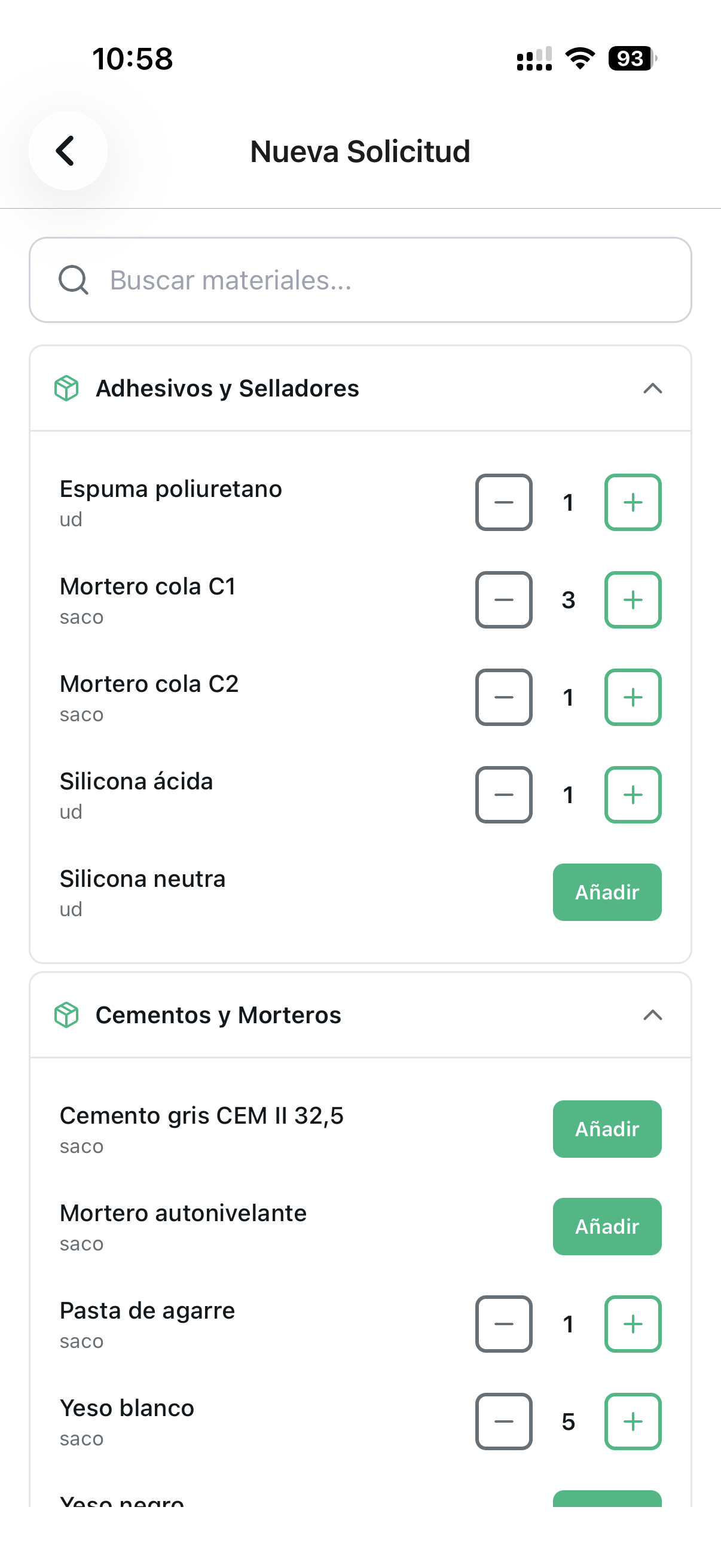
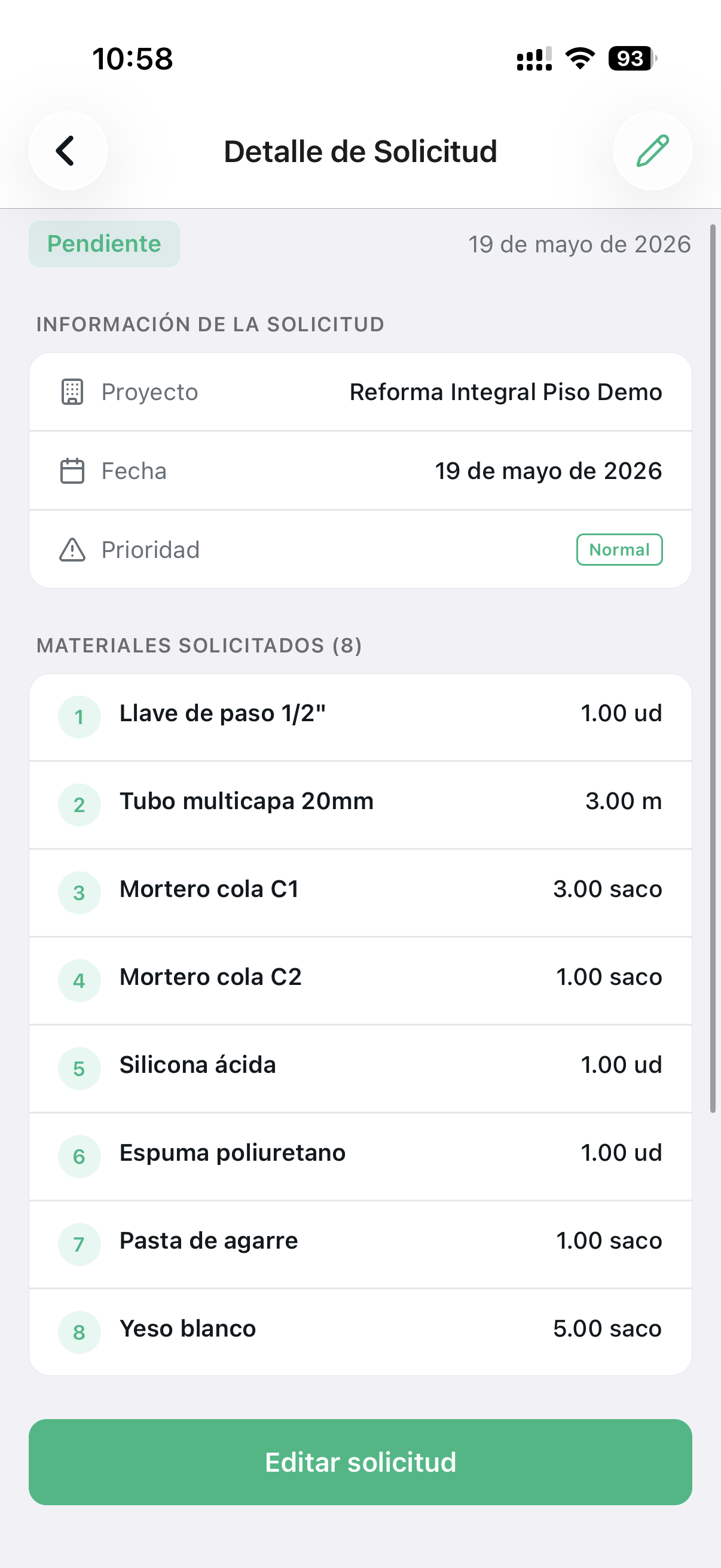
The operative or foreman on site notices something is missing. Instead of a voice note in the chat, they open the app and create a request with a specific material, quantity, urgency level (normal, urgent or critical), the project it is charged to and, if useful, a photo of the problem.
The material should be selected from a catalogue, not typed as free text. If the product is not in the catalogue yet, in Tabiquo you can paste the manufacturer's product URL: the AI importer extracts image, brand, dimensions and design specs in seconds and the product is added to the company catalogue. If the foreman types "plaster" instead of the exact reference, the matching engine suggests the most likely catalogue entry, so the history does not get polluted with free-text variants.
The request starts as a draft, moves to pending approval when the foreman submits it and ends up approved or rejected based on the procurement lead's decision. If only part of the request gets fulfilled, it is explicitly marked as partially fulfilled — the rest stays live in the system, never assumed away. And when one request needs to be split between two suppliers — because one is out of stock on half the items, or it is cheaper to divide — the request can be split into derivatives without losing traceability to the original.
Every request is linked to its project and the user who raised it. No ambiguity about who asked for what and when.
Stage 2: Purchase order and quote comparison
The procurement lead consolidates approved requests from multiple sites and operatives into purchase orders to suppliers. This is where money is made or lost.
Consolidation. Grouping requests that can ship together avoids repeated delivery charges and unlocks volume discounts. If it later makes sense to split the PO across two suppliers, the order can be divided while preserving the link to the originating requests.
Quote comparison. For specialist materials, getting two or three quotes before issuing a PO matters. Tabiquo runs this with a multi-supplier quote request: each supplier gets a public link — no account required — where they upload their quote, and the procurement lead compares totals and lead times on a single screen. The quote request moves from draft to sent, into a comparison phase and ends with the awarded supplier.
Internal approval. Above a certain value, the PO needs a sign-off. This kills the verbal approvals nobody remembers and makes it clear who authorised what.
Auto PDF and trackable email. When a PO is sent, Tabiquo generates the PDF, attaches it to an email and queues the send. The email has its own state — queued, sent or failed — so if the supplier never receives it because of a bounce or a dead domain, you know immediately instead of finding out when the material does not arrive.
The PO walks through the usual states: draft, sent, confirmed, invoiced, paid, closed. Every transition is logged with who and when. For on-site emergencies paid on the spot without going through a request, a quick purchase flow creates the PO directly while still charging it to the right project. And for third parties who are not yet repeat suppliers — a subcontractor or a freelancer you are asking for a one-off quote — Tabiquo has a commitments flow with its own public upload link: the third party attaches their quote without signing up and it lands inside the project file.
If procurement and documents are connected, so is everything else: each PDF, quote and invoice in the flow lands in the project file automatically, no email forwarding required. We cover the wider picture in the digital transformation guide for construction.
Stage 3: Delivery
This is where most companies lose traceability. A delivery is not just "the truck showed up": Tabiquo distinguishes three delivery methods — pickup at warehouse, direct to site and direct to HQ — and each can be composed of several stops if the truck covers multiple addresses.
What needs to be recorded on arrival:
- Who received it, with photo and signature.
- What was unloaded (actual quantities, which rarely match the PO 100%).
- Item condition: damaged, missing or surplus.
- The physical or digital delivery note, photographed on the spot.
Each stop has its own state (pending, delivered, failed or cancelled) and its own signature, so on a multi-stop run you know exactly what arrived where and what remained outstanding.
The biggest operational differentiator is that every delivery is converted automatically into real tasks in the planning system: when a delivery is created, the system generates a pickup task (where applicable) and a sub-task per stop, assigned to the transporter role. The transporter sees them in their schedule, marks each stop complete with photo and signature, and the office knows in real time whether the truck is running late. There is no parallel planning board to keep in sync.
Stage 4: Three-way reconciliation
The invisible stage where the money is actually controlled. Three documents need to match:
- What you ordered — the purchase order.
- What you received — the delivery note.
- What the supplier is charging — the invoice.
If those three documents do not reconcile automatically, someone has to do it by hand every time. More importantly, this is the seam where wrong charges slip through: inflated quantities, materials that never arrived, prices that drift from the quote.
Tabiquo automates this in three steps:
- Delivery-note OCR. Photograph the delivery note on site and the system extracts references, quantities and prices — no typing.
- Line-by-line matching. Every line of the delivery note is compared automatically with the lines of the originating PO and the discrepancies are flagged (missing quantity, different price, unexpected reference). You only review what needs human attention.
- Invoice OCR. When the supplier's invoice arrives, the same engine extracts the lines and proposes the reconciliation against delivery notes that are still pending invoicing. One invoice can cover multiple delivery notes; the system shows you the summary and you confirm.
Delivery-note state — pending, delivered, invoiced — makes it clear at any moment whether a given delivery has already been billed or is still outstanding. And because the supplier upload links accept both quotes and invoices, the supplier can attach the invoice through the same public link instead of sending loose emails the office will have to organise later.
If you want a broader picture of what the right software stack looks like, see our guide to construction management software for small teams.
Chat + Excel vs. an integrated system
| Aspect | Chat + Excel | Integrated system |
|---|---|---|
| Where requests start | Audio or text lost in a chat | Structured request with material, quantity, urgency and project |
| Price history | Reconstructed by hand | Available instantly by material and supplier |
| Quote comparison | Email attachments hunted down later | A single screen with all offers side by side |
| Per-project traceability | Manual filtering each month | Automatic, real-time imputation |
| Delivery notes | Wet paper or a photo lost in a chat | OCR + automatic matching against the PO |
| Invoice reconciliation | Manual PDF cross-checking | Three documents reconciled in seconds |
| Site access | Excel is impractical on a phone | Native app designed for the foreman |
Common mistakes when digitising procurement
- Not training foremen. If only the office uses the app, you have not solved the problem. Adoption has to start on site.
- Catalogue too open. If every operative can type "plaster" as free text, you will not get useful history. Define a material catalogue with codes and let the matching engine clean up the rest.
- No approval thresholds. Without a value above which a PO needs sign-off, anyone can buy anything and nobody actually controls spend.
- Skipping the delivery note. "The invoice will turn up, it is fine." It is not fine: the delivery note is the proof of what was received. Without it, the invoice is just the supplier's word.
Frequently asked questions
What is the difference between a material request and a purchase order? The request is created by the foreman on site when something runs out. The purchase order is issued by the procurement lead, grouping several approved requests and choosing the supplier. The separation between the two is what makes consolidation and negotiation possible.
Can suppliers upload their quote without a Tabiquo account? Yes. Each quote request or order generates a public link the supplier opens without registration. The same link accepts both the upfront quote and the later invoice.
What happens if a delivery arrives incomplete? The delivery note is recorded with the actual quantities received. The system flags the discrepancies against the PO and the originating request stays in a partially fulfilled state until the rest arrives. The office knows without effort what is still outstanding.
Can one invoice cover multiple delivery notes? Yes. A single invoice can span several delivery notes from the same supplier; when the invoice is uploaded, the OCR extracts the lines and proposes the reconciliation against the open delivery notes, and you confirm.
Does it work for a foreman who is not particularly tech-savvy? That is the primary use case. The mobile app is designed for creating a request, photographing a delivery note and signing for a delivery with no prior training.
Conclusion
Controlling site procurement is not a software problem — it is a process problem. But without the right tool, the process is impossible to sustain. The foreman drops back to the informal chat the moment friction goes up, and the whole thing slides off the rails again.
The flow that works is always the same: a structured request from site, a consolidated PO from the office, a delivery recorded in the moment and turned into real tasks for the transporter, automatic three-way reconciliation against delivery note and invoice. Once it is running, you stop arguing with suppliers, stop paying invoices on trust and start negotiating with data.
If you want to see how it fits your company, try the Tabiquo demo and set up a sample project in fifteen minutes.