


Introduction
"I told the foreman" is the sentence many claims against a site supervisor start with. Not because they did not say it, but because they cannot prove it. A supervisor's liability is decided less on site than on paper: it is not enough to have supervised, you must be able to show it two years later, in front of an expert who was not there.
This article sets out what a site supervisor answers for, which documents make up their defence and — the question we are asked most — what minutes signed from a phone through a link are worth without a qualified electronic signature.
What the supervisor answers for
In Italy the direttore dei lavori owes the client a duty of qualified diligence (Civil Code arts. 1176 and 2236): not a presence on site every hour, but a "high" level of supervision, with visits as frequent as the phase of the works requires, and action when deviations are found. In Spain the dirección facultativa (the architect directing the works and the technical architect controlling execution) answers under the Building Act (LOE, art. 17) for material damage caused by defects attributable to their lack of diligence, jointly where the cause cannot be attributed.
In practice the judge's question is the same everywhere: what did you see, when, and what did you order. A supervisor who can answer with dated documents is in a very different position from one who answers from memory.
The documents that defend you
No single document is a defence. Together, they tell the story of the supervision:
- The visit minutes prove attendance: when, with whom, what was checked, with what result, which defects were found and who they were assigned to. They document the frequency and the content of supervision.
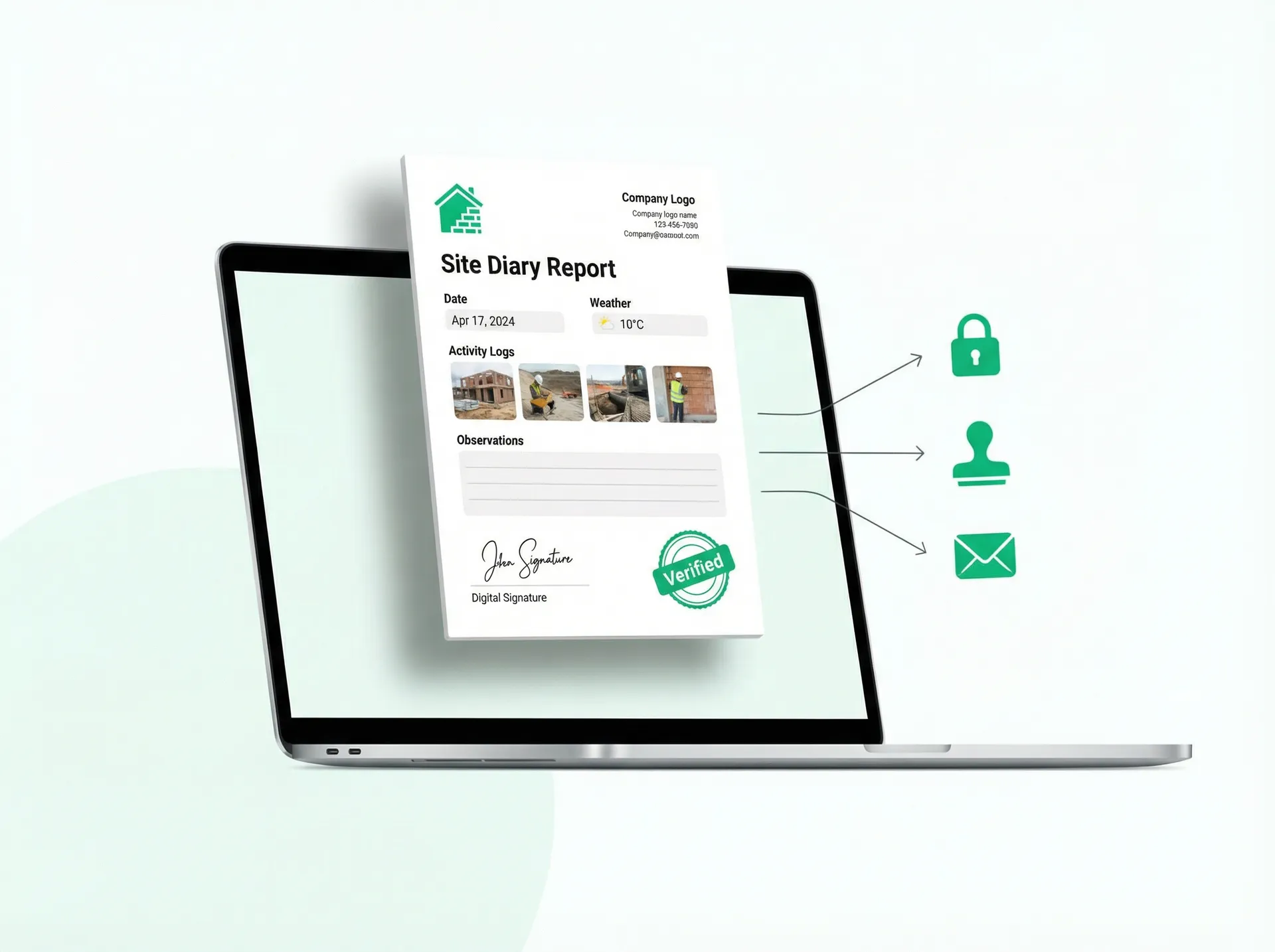
- The site diary proves continuity: works, attendance, weather and, above all, the numbered and dated service orders. It shows the supervisor did not only look, but ordered.
- Defects (non-conformities) prove the reaction: each has a number, a photo, a severity, an assignee and a resolution date. A defect found and closed is a defence; one found and forgotten is an admission.
- The approved payment certificate proves the quantities paid match verified work.
- Formal notices to the client when the contractor ignores an order.
The common thread is a certain date and the contractor's knowledge: a document the contractor signed, or was sent with a trail, weighs far more than one left in the supervisor's drawer.
What link-signed minutes are worth
Precision matters here, because the market promises more than the law grants.
Minutes the contractor signs from their phone by opening a link and drawing a signature on the screen are, in the language of the eIDAS Regulation, a simple electronic signature: not a qualified one, and without the evidential force of a witnessed handwritten signature. But they are not worthless either. Article 25 of eIDAS provides that an electronic signature cannot be denied legal effect solely because it is not qualified: its weight is assessed freely by the court according to the security and integrity guarantees of the system.
What makes that assessment favourable:
- Document integrity. The minutes' PDF is sealed when closed and archived with its SHA-256 fingerprint. Anyone holding the file can recompute it and compare it with the one shown on the signing page and in the email: if they match, the document is the one. This does not prove nobody touched the database — it proves that PDF is identical to the one archived that day, and that the fingerprint left the system (by email, on the page, in print) at that moment.
- The signature trail. For each signature the system records who the link was sent to, when it was opened, the IP address, browser and device, the signature image and the fingerprint of the signed document. It is the digital equivalent of "signed on site, in the presence of".
- Contemporaneity. The minutes are generated and signed on the day of the visit, not reconstructed weeks later. Photos carry their capture date.
- Knowledge. The link went to a contractor's address; opening and signing prove the contractor had the document. Even an unsigned request, with a tracked delivery, proves knowledge.
Together these four things make link-signed minutes robust, verifiable evidence: far stronger than a PDF emailed without a signature, and incomparably stronger than a chat message. They do not replace a qualified signature where the law requires one (for instance in certain filings with public authorities); for a supervisor's oversight of a private job, they are what is needed.
What not to promise
Out of honesty towards the client and yourself:
- The seal does not prove the system was never altered by whoever runs it; it proves the file in someone's hand is identical to the archived one. That is why the fingerprint must leave the system — in the email, on the signing page, on the printed copy.
- A simple signature does not carry the presumption of authenticity of a qualified one. Whoever disputes it may; the trail is there to make the dispute implausible.
- Perfect minutes do not cover non-existent supervision. If there were two visits in six months, the minutes prove exactly that.
How to organise yourself
- One visit, one set of minutes, the same day. Dictated on site, with room-by-room photos and a checklist, generated with one tap and closed before leaving.
- The contractor signs on the spot, from their own phone, via QR. If they cannot, they receive the link: the delivery is tracked.
- Every defect is a ticket with an assignee and a deadline, followed to closure.
- Orders go in the diary, numbered and dated, never only by voice or chat.
- The archive belongs to the practice, not the contractor: change contractor, the documents stay.
Conclusion
A site supervisor is not defended by memory but by documents: minutes, diary, defects, certificates, each with its date and with proof the contractor saw it. Link-signed, sealed and tracked minutes are not a qualified signature — but they are evidence a court can weigh and a contractor struggles to deny.
See how Tabiquo produces these documents from a phone on the site supervision page.