


Introduction
The payment certificate is where a site turns into money. The contractor says how much it has done, the supervisor says whether that is true, the client pays. Everything the diary and the minutes told as a story becomes, in the certificate, a number with a signature under it. That makes it the most contested document of a building contract, and the one most worth keeping in order.
This guide explains what an interim certificate is on Italian and Spanish sites (the SAL and the certificación de obra), how it is built from the accepted estimate, who approves it and what they take on, how retention and advances work, and how a supervisor can run the whole cycle from a phone with the contractor signing from a link.
What the certificate is
An interim payment certificate is the periodic document (monthly as a rule) that records the quantities of every work item executed to date and values them at contract prices. From it follows the amount the client owes the contractor for the period, net of retention and advances already paid.
The certificate always reasons to date: each one carries the total executed since the start of the works, and the period's amount is the difference from the previous certificate. A mistake in one certificate carries into all the following ones, which is why the first has to be right.
How it is built
- The accepted estimate. The certificate rests on the items of the accepted bill of quantities: same numbering, same units, same prices. Approved change orders enter as additional items at their agreed price.
- Quantities executed. For each item the quantity done in the period, or the percentage complete, is recorded. Most arguments start here: is an "almost finished" item 90 % or 60 %? The answer lies in the specification and, failing that, in a check on site.
- The supervisor's check. The supervisor compares what is declared with what they saw on their visits and recorded in the diary. Room-by-room photos and open defects are the cross-check: an item with an open non-conformity is not 100 %.
- Retention and advances. Retention under the contract is deducted from the period's gross (0.5 % on Italian public works, 5 % as the Spanish norm, contractual on private jobs), the advance share is recovered and VAT is calculated. The net is the amount payable.
- Approval and signature. The supervisor approves; from that moment the certificate is not touched. Contractor and client sign to acknowledge and accept it.
Who approves, and what they take on
Approving a certificate means attesting that the work items were executed properly and to that extent. It is an act of the site supervisor, not of the office that filled in the spreadsheet: the office prepares, the supervisor approves. A certificate approved without checking exposes the supervisor to the client if the quantities turn out inflated, and to the contractor if the payment is later disputed.
The correct flow therefore separates the two steps: whoever prepares submits the certificate, whoever supervises approves it, and only the approval locks the document.
Italy and Spain side by side
- Periodicity. In Spain the monthly certificate is statutory on public works and standard practice on private ones; in Italy the contract sets the SAL's frequency, and each SAL is followed by a certificato di pagamento.
- Retention. Italy: 0.5 % on public works, released at final inspection (collaudo), contractual on private jobs. Spain: 5 % as a rule, released at the end of the defects period.
- Who signs. Italy: the direttore dei lavori. Spain: the dirección facultativa (the architect and the technical architect, each for their part). The logic is the same everywhere: whoever supervises certifies, whoever executes accepts, whoever pays acknowledges.
- VAT. 22 % in Italy (10 % on many refurbishments), 21 % in Spain (10 % in comparable cases).
Tabiquo calculates the certificate with the rate and the vocabulary of the team's country, so the same flow produces a SAL in Milan and a certificación in Madrid.
The certificate from a phone
With Tabiquo the cycle closes without spreadsheets circulating by email:
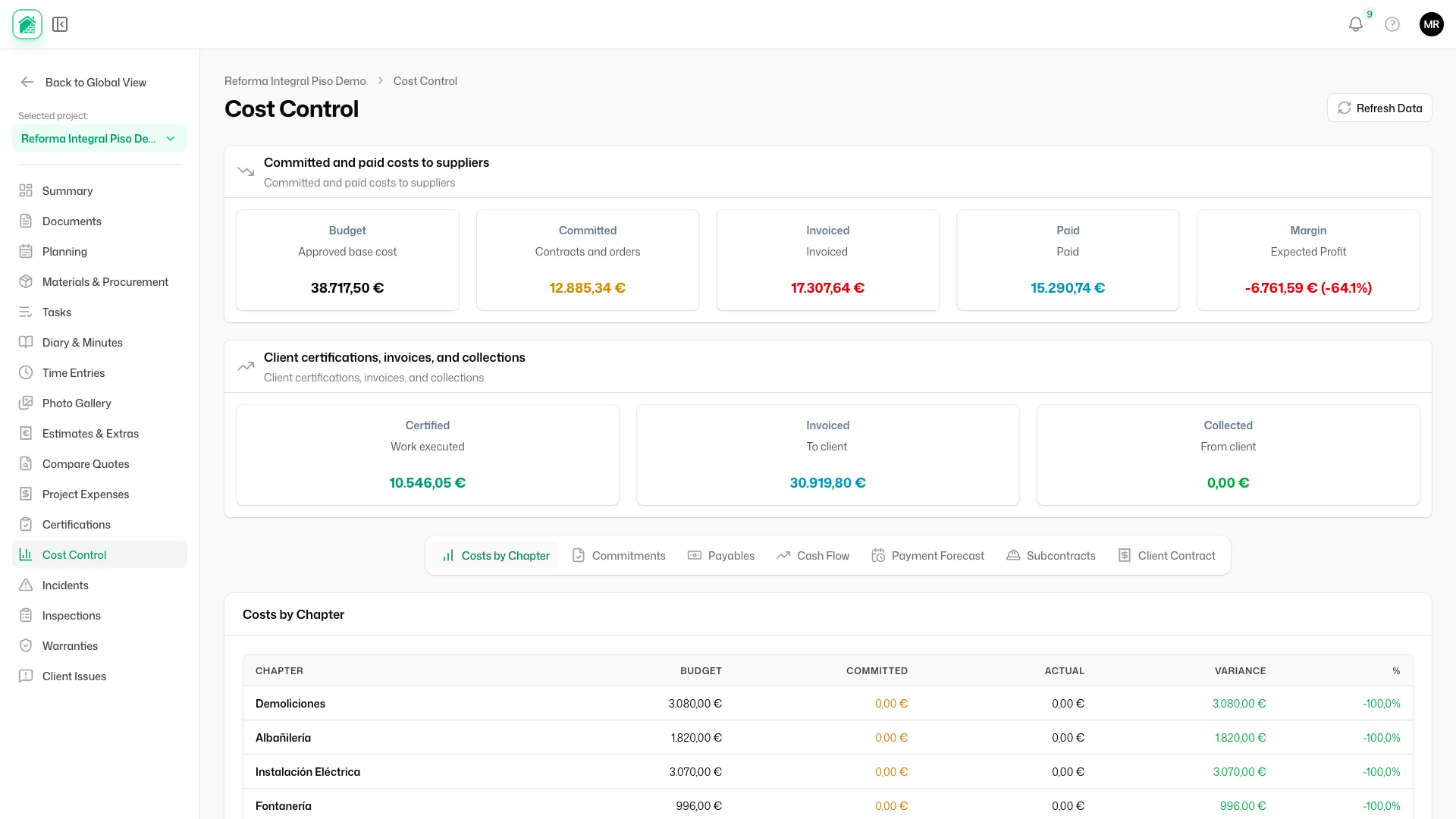
- The office prepares the certificate from the accepted estimate's items, with percentages to date and automatic retention, advance and VAT.
- The supervisor receives it, compares it with the visits and the diary of the same site and approves it: the certificate locks, renders to a PDF on the practice's letterhead and is sealed with its SHA-256 fingerprint.
- The supervisor signs it, then asks the contractor and the client to sign from a link: no account, nothing to install. Each signature records date, time and device.
- The client sees the approved certificate in their app, beside progress and minutes.
A wrong certificate is not corrected in place: a correcting certificate is issued from the previous one and keeps its history.
Common mistakes
- Approving without checking. The supervisor's signature is an attestation, not an acknowledgement.
- Percentages by feel. Without a written rule for partial items, every certificate is a negotiation.
- Forgetting change orders. An executed change order left out is a contractor's credit that resurfaces at the end, when it hurts most.
- Correcting in place. An approved certificate that is later edited proves nothing any more.
Conclusion
The certificate is the signature that turns a site into a payment. Prepared by the office, checked and approved by the supervisor, sealed and signed by the parties, it holds. Done on a spreadsheet that travels by email, it is the start of the next dispute.
See how a supervisor approves and signs the certificate from a phone on the site supervision page.