


Introduction
The site diary is the document that most often exists only on paper: a notebook in the site hut, filled in every other week, that nobody reads until something goes wrong. Then a dispute over delay, a contractor's claim, an accident or an inspection turns it into the only day-by-day account of what happened on site, and by then it cannot be reconstructed.
In Italy the giornale dei lavori is written into the public-works regulations and expected by practice on private jobs; in Spain the libro de órdenes y asistencias is a statutory book the supervising architect must keep. The names differ, the purpose does not: the supervisor's own record, separate from the contractor's. This guide sets out who keeps it, what it must contain and how to keep it from a phone without losing its weight as evidence.
Who keeps it
The diary belongs to the site supervisor (the direttore dei lavori or dirección facultativa), or to an assistant acting under their responsibility. It is not the contractor's document: the contractor reads it, acknowledges it and signs it, but the pen belongs to the supervisor. Where the supervisor is not on site every day, the assistant records the facts and the supervisor validates them.
The safety coordinator does not keep the diary, but their visits and instructions are recorded in it: that is how you show safety was followed, not merely planned.
What it must record, every day
A diary that stands up to scrutiny records, for every working day:
- The works carried out, by area or phase, in enough detail to tell what was being done rather than "works in progress".
- Contractor and subcontractor attendance: how many people, from which company, in which role. On sites with several contractors this is the entry that matters most after an accident.
- The weather and anything that suspended or slowed the works: rain, frost, a missed delivery. These are the facts that later justify extensions of time.
- Service orders issued by the supervisor, numbered in sequence and dated, with their subject and, where there is one, the contractor's reply.
- Instructions (technical or safety), also numbered.
- Visits by the supervisor, the safety coordinator, the final inspector and any authority.
- Remarks: delays, deviations from the design, approved samples, decisions taken on the spot.
Entries are made on the day they refer to. A diary written up at the end of the month loses its main strength, which is that the fact and its record are contemporaneous.
The question of evidential weight
A site diary is a private record kept by one of the parties, not a public deed. Its weight in a dispute rests on three things: that it was kept day by day, that the contractor knew of the entries (signature, acknowledgement or delivery) and that it is intact, so that a later rewrite cannot be suspected.
That is where paper falls short: a notebook can be rewritten and a torn page leaves no trace. Digital record-keeping, done properly, solves exactly this: every closed day produces a PDF that cannot be edited and a fingerprint (hash) anyone can verify.
Keeping it from a phone
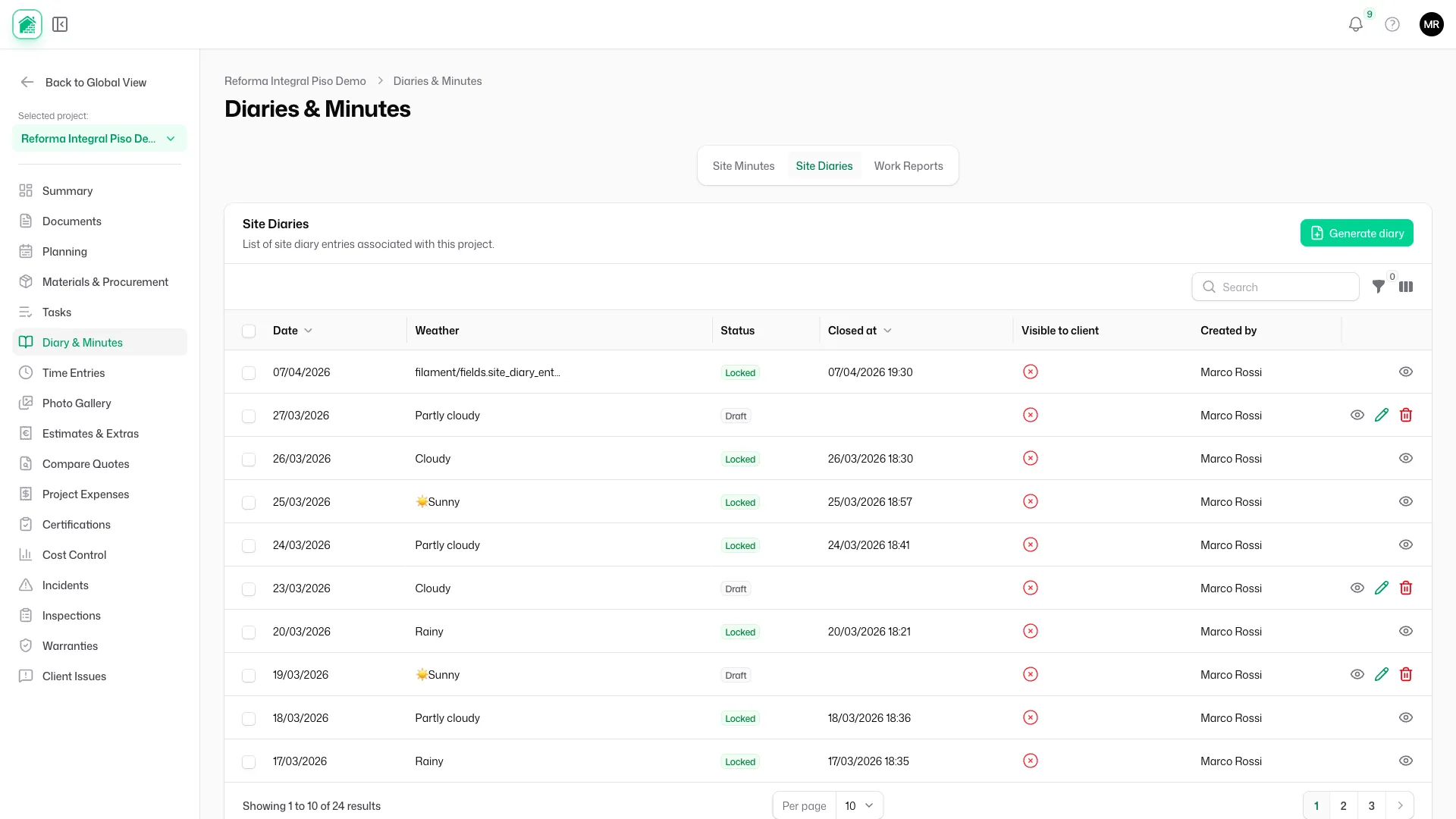
A supervisor running three sites does not go back to the office to fill in three diaries. With Tabiquo the diary is kept where it happens:
- Every day is a page of the diary in the app, created automatically on the site's working days. Works are typed or dictated, contractor attendance is entered by company and headcount, the weather is picked from a list.
- Service orders and instructions have their own section on the supervisor's page: every entry gets a sequential number per site and a date. A supervisor's or coordinator's visit is logged with one tap.
- Photos attach to the work item, not to a separate album, with their capture date.
- The day is closed: the PDF is generated, archived and sealed with its SHA-256 fingerprint. From then on it cannot be edited; a correction produces a new version that keeps the history of the previous one.
- The contractor signs the day from a link or a QR code, with no account. The signature records date, time and device.
The result is a diary that exists every evening, that the contractor has seen, and that nobody can rewrite.
Mistakes to avoid
- Filling it in by blocks. Three weeks written in one afternoon are recognisable at a glance, and weigh accordingly.
- Recording only the good news. A diary with no delays, no deviations and no service orders is not a perfect site; it is a diary that was not kept.
- Confusing the supervisor's diary with the contractor's. The first belongs to the supervisor, the second to the contractor. If the contractor changes, the supervisor's diary must stay with the supervisor.
- Service orders by voice or chat. An order that is not numbered and dated in the diary is advice, not an order.
Conclusion
The site diary is worth what it proves: that the supervisor was there, saw, and gave orders. Kept day by day, signed by the contractor and sealed, it is the cheapest defence a supervisor can have. Kept at the end of the month in a notebook, it is a risk with a cover.
With Tabiquo the diary is kept on site from a phone, service orders are numbered and dated, and every closed day is a sealed PDF the contractor signs from a link. See how each day gets recorded on the digital site diary page and, for the rest of the supervisor's file, on the site supervision page.